
CHETAK
Coal Mine Hazard Evaluation and Tracking Assessment Kit
Coal-Mine Safety • Robotics • IoT • Health Monitoring
CHETAK received a Special Prize during the Environmental Hackathon 2024 associated with the International Conference on Environmental Challenges, Opportunities and Sustainable Solutions at the Centre for the Environment, IIT Guwahati. It also secured First Prize at the Regional-Level RSVBP and received seed-funding support of ₹1.20 lakh from QiskitQ Technologies for the development of CHETAK 2.0.
Introduction
Underground mining poses significant risks due to the accumulation of toxic gases, lack of ventilation, and delayed response mechanisms. Conventional detection systems often lack real-time adaptability or are limited to isolated sensor functionality.
CHETAK was conceptualized to address this need using a multi-sensor, embedded platform that provides local alerts and remote updates to supervisors. It enhances mine safety by ensuring that dangerous gas levels, elevated temperatures, or health emergencies are detected immediately.

Abstract
The CHETAK system is a next-generation smart safety solution designed for real-time gas detection and health monitoring in underground coal-mining operations. It integrates multiple sensors, including MQ-series gas detectors, environmental sensors, and biomedical modules to monitor methane (CH₄), carbon monoxide (CO), hydrogen (H₂), carbon dioxide (CO₂), temperature, humidity, SpO₂, and pulse rate.
The system leverages microcontroller-based computation with wireless alert systems such as LoRa and GSM for local as well as remote notifications. The aim is to reduce accidents, enhance responsiveness, and support mine safety through data-driven alerts and monitoring.
Awards, Recognition and Funding
First Prize in Disaster Management
Regional-Level Rajya Stariya Bal Vaigyanik Pradarshani 2024–2025.
View CertificateEnvironmental Hackathon 2024
Special Prize in the School Student Category at ENVIRONMENT 2024, an International Conference on Environmental Challenges, Opportunities and Sustainable Solutions, organised by the Centre for the Environment, IIT Guwahati.
View Certificate₹1.20 Lakh for CHETAK 2.0
Seed-funding support provided by QiskitQ Technologies for the development of the next version.
View Funding LetterFeatures
- Gas Detection: Monitors CH₄, CO, H₂ and CO₂ with real-time alerts.
- Fire Safety: Includes a water sprinkler to extinguish fires.
- Health Monitoring: Tracks SpO₂ and blood pressure remotely.
- Communication: Equipped with a speaker and microphone for real-time miner–control-room interaction.
- Night-Vision Camera: Provides a live video feed even in dark underground environments.
- RTC Module: Provides real-time date and time information for the display.
- Benefits: This cost-effective mobile system reduces the need for miners to enter dangerous zones, prevents exposure to harmful gases, and supports quick emergency responses while prioritising human safety.
Product Description
- Gas Sensors — MQ-4, MQ-7, MQ-8 and MQ-135: Detect methane, carbon monoxide, hydrogen and carbon dioxide gases.
- Temperature and Humidity Sensor — DHT22: Monitors environmental temperature and humidity.
- Night-Vision Camera: Provides a real-time video feed.
- I2C LCD Display: Displays real-time sensor data.
- Buzzer: Generates an alert when gas levels exceed the selected safety thresholds.
- Microcontroller: Processes sensor data and controls monitoring, communication and alert functions.
- Fire-Suppression System: Uses a sprinkler for fire emergencies.
- SpO₂ Sensor — MAX30100: Monitors blood-oxygen level and heart rate of miners in real time and supports alerts for health risks associated with low oxygen levels underground.
- RTC Module: Provides real-time date and time information for display and data records.
Technical Description
The CHETAK system is built around the Arduino Uno microcontroller. It uses various gas sensors, including MQ-4, MQ-7, MQ-8 and MG811, a DHT11 temperature and humidity sensor, an RTC DS3231 module for real-time clock data, and an SD card module for data logging.
Alerts are sent using a GSM module, ensuring immediate notification when potentially dangerous conditions are detected.
Scientific/Working Principle
Scientific Principle Involved
The CHETAK system operates on the principles of gas sensing, environmental monitoring, and optical detection. Semiconductor gas sensors such as MQ-4, MQ-7 and MQ-8 detect hazardous gases through changes in electrical resistance, while the DHT11 monitors temperature and humidity.
The MAX30100 uses optical detection to measure SpO₂ and heart rate, and the night-vision camera provides visibility using infrared light.
Working Principle of CHETAK
The gas sensors in CHETAK detect gas levels, temperature, humidity, and health data. The Arduino processes this information and triggers alerts when unsafe conditions are identified.
The system also provides real-time visual monitoring and sensor-data monitoring, supporting safety assessment in underground coal mines.
Components Used
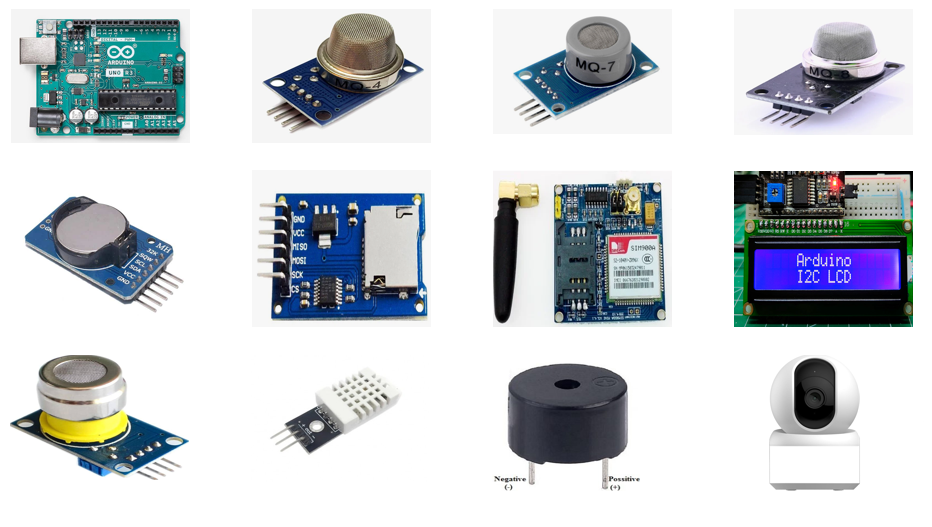
- Arduino Uno
- MQ-4 Methane Sensor
- MQ-7 Carbon Monoxide Sensor
- MQ-8 Hydrogen Sensor
- MG811 Carbon Dioxide Sensor
- DHT11 Temperature and Humidity Sensor
- RTC DS3231 Module
- SD Card Module
- GSM SIM900A Module
- I2C LCD Display
- Buzzer
Methodology
- Researching coal-mine hazards and existing monitoring systems.
- Designing a robust sensor array and integrating it with the Arduino Uno.
- Implementing real-time gas detection and environmental monitoring.
- Enabling wireless alerts through SMS to relevant authorities.
- Testing the system in simulated hazardous environments for validation.
Experimental Results
The supplied project document presents photographs of the completed CHETAK prototype under the Experimental Results section. The prototype demonstrates the physical integration of the mobile platform, gas sensors, environmental sensors, displays, camera, communication modules and alert system. Separate numerical experimental values were not included in the supplied project document.
Future Scope
- Integration of AI-based hazard-prediction algorithms.
- Improved wireless range for remote underground monitoring.
- Additional gas detection for SO₂ and NOx to provide expanded safety monitoring.
- Enhanced communication with real-time video monitoring.
- Deployment in other hazardous environments, including oil refineries.
CHETAK in the News
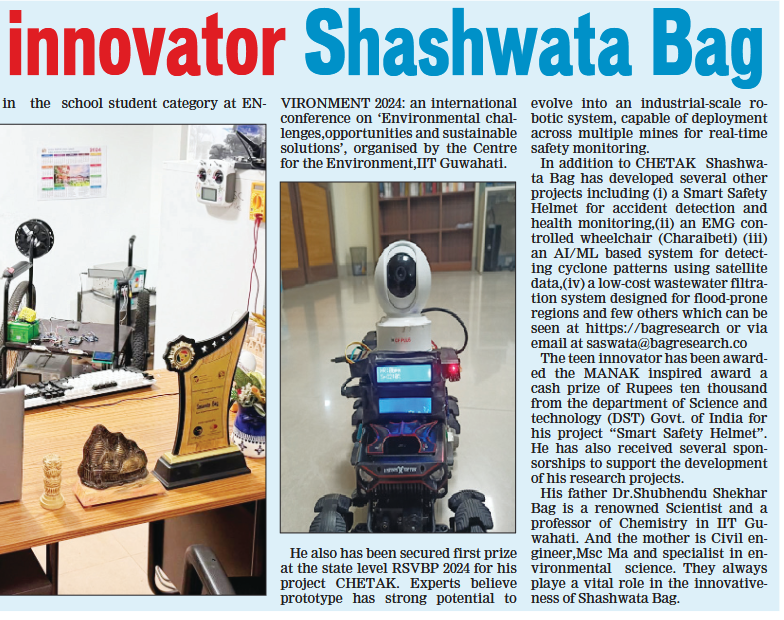
Teen Innovation for Coal-Mine Safety
CHETAK was featured in the Eastern Chronicle for its approach to real-time mine-hazard detection, environmental observation and worker-health monitoring. The article highlighted the use of an unmanned mobile platform to reduce direct human exposure to hazardous underground conditions.
Read Newspaper FeatureProprietary Project — All Rights Reserved
CHETAK is not an open-source project. Its design, documentation, software, circuit architecture, images and technical material may not be copied, reproduced, modified, redistributed or used commercially without prior written permission, except where permitted by applicable law.