Advancing Research. Building The Future | Welcome To The Website Of Saswata Bag

Advanced Mine Safety • Artificial Intelligence

CHETAK 2.0

Next-Generation Coal Mine Hazard Evaluation and Tracking Assessment Kit

CHETAK 2.0 is the proposed next-generation development of the original CHETAK mine-safety platform. It is intended to combine advanced environmental sensing, artificial intelligence, live communication, emergency response and worker-support functions in an unmanned mobile system.

Development: 10% Completed AI-Assisted Monitoring Emergency Support Seed Funded Not Open Source
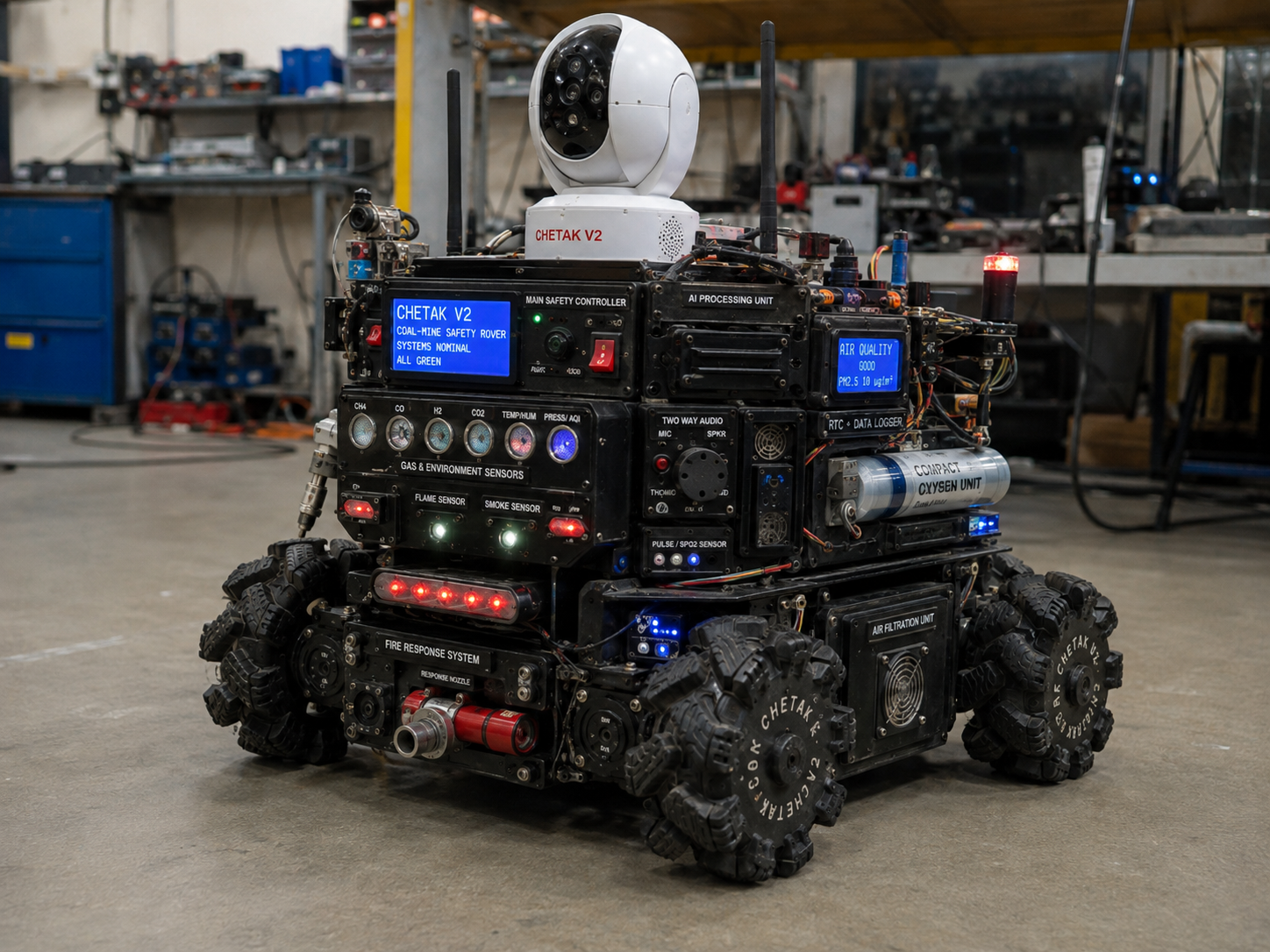
Illustrative concept of the proposed CHETAK 2.0 coal-mine safety platform
Image is for illustration purposes only. The final prototype, chassis, sensors, dimensions, colours and component arrangement may differ.
Proprietary Project — All Rights Reserved

CHETAK 2.0 is not an open-source project. Its concept, design, documentation, source code, artificial intelligence architecture, circuit design, images and technical material may not be copied, reproduced, modified, redistributed or used commercially without prior written permission, except where permitted by applicable law.

Project Overview

Abstract

Need for the Next Generation

Underground coal mining involves risks from toxic gases, smoke, fire, poor visibility, difficult communication, environmental instability and delayed emergency response. Entering an unknown area can expose miners and rescue personnel to avoidable danger.

The original CHETAK demonstrated the possibility of using an unmanned mobile system for multi-gas, environmental and worker-health monitoring. CHETAK 2.0 is intended to extend this concept through more advanced sensing and intelligent assistance.

Proposed Solution

CHETAK 2.0 is planned as an advanced unmanned mobile safety platform capable of entering hazardous underground areas and transmitting sensor data, visual information and warnings to authorised personnel.

Proposed functions include AI-based camera analysis, gas monitoring, fire and smoke detection, environmental observation, communication, air-filtration support, emergency oxygen support and remote medical consultation.

Keywords: Coal-mine safety, artificial intelligence, environmental sensing, robotics, emergency response, gas monitoring and remote communication.

Current Project Stage

Development Status

Approximately 10% Completed

10%

CHETAK 2.0 is presently at the research, feature-planning and system-architecture stage. The principal functions and proposed subsystems have been identified. Detailed component evaluation, procurement and subsystem prototyping will follow.

Completed

Problem Study

The limitations of the first CHETAK prototype and the requirements for an advanced version have been studied.

Completed

Feature Planning

Major features such as AI monitoring, fire response, filtration, oxygen support and remote medical communication have been identified.

Current

System Architecture

The electronic, mechanical, communication and safety architecture is presently being planned.

Next

Component Procurement

Suitable sensors, processing units, cameras, communication modules, motors and safety components will be evaluated and procured.

Next

Subsystem Prototyping

Gas sensing, artificial intelligence, communication, movement and alert subsystems will be developed separately.

Future

Integrated Prototype

Validated subsystems will be combined into an integrated next-generation mobile platform.

Future

Controlled Testing

Testing will be conducted in safe simulated environments before considering specialised field trials.

Evolution of the Platform

From CHETAK to CHETAK 2.0

Original CHETAK

  • Methane, carbon monoxide, hydrogen and carbon dioxide monitoring.
  • Temperature and humidity monitoring.
  • Pulse-rate and blood-oxygen observation.
  • Night-vision camera.
  • GSM alerts and data logging.
  • Two-way audio communication.
  • Unmanned mobile operation.

Proposed CHETAK 2.0 Advancement

  • AI-assisted visual analysis.
  • Improved environmental and gas sensing.
  • Fire and smoke detection.
  • Experimental fire-response mechanism.
  • Air-filtration support.
  • Emergency oxygen-support concept.
  • Remote medical-guidance interface.
  • Online doctor and control-room communication.
  • Improved data recording and analysis.

Planned Functions

Proposed Capabilities

These capabilities represent the current development plan and remain subject to component selection, engineering feasibility and experimental validation.

01

Advanced Gas Monitoring

Planned continuous monitoring of methane, carbon monoxide, hydrogen, carbon dioxide and other hazardous underground gases.

02

AI-Based Visual Detection

An AI-enabled camera system is proposed for detecting people, obstacles, smoke, flames and unusual conditions.

03

Fire Detection and Response

Planned fire and smoke sensors will provide early warnings and activate an experimental fire-response mechanism.

04

Environmental Monitoring

Temperature, humidity, pressure and air-quality information will be collected for real-time underground assessment.

05

Worker Health Monitoring

The proposed system will support pulse rate, blood-oxygen and other basic worker-health observations.

06

Emergency Oxygen Support

A compact emergency-oxygen support concept is being considered for temporary assistance during critical situations.

07

Air-Filtration Support

An experimental air-filtration subsystem is proposed to reduce selected airborne contaminants around the platform.

08

Remote Communication

Two-way audio, video, GSM and wireless communication are proposed for interaction with the mine control room.

09

AI Medical Guidance

A future decision-support interface may provide basic emergency guidance while professional medical assistance is contacted.

10

Online Doctor Consultation

The communication system is intended to support remote consultation with a doctor or emergency-response professional.

11

Location and Route Tracking

The platform is planned to record its route and provide position information using suitable mine-compatible tracking methods.

12

Automatic Data Logging

Sensor readings, alerts, time records and operational events will be stored for later analysis and investigation.

Preliminary System Architecture

Proposed Subsystems and Components

Final hardware has not yet been fixed. The component architecture may change following technical evaluation, power analysis and safety testing.

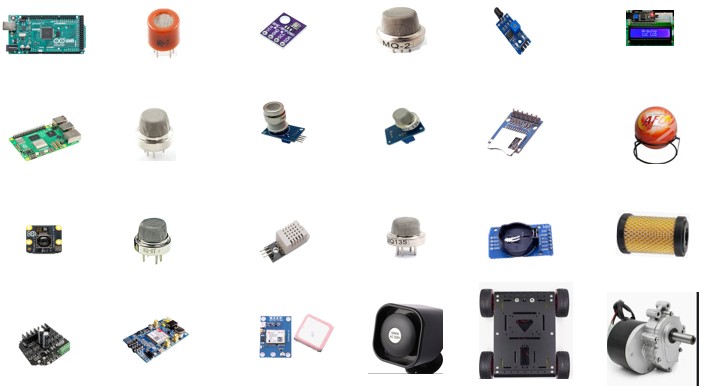
Illustrative proposed components for CHETAK 2.0
Components image is for illustration and planning purposes only. The final modules, PCB, sensors, chassis and circuit arrangement may differ.
Main Safety Controller Controls sensing, local warnings, movement, communication and emergency-response functions.
AI-Capable Processing Unit Processes camera input and supports experimental visual detection and intelligent decision assistance.
AI Camera with Night Vision Provides live visual monitoring and proposed detection of people, obstacles, smoke and fire in low-light conditions.
Methane Gas Sensor Measures methane-related sensor responses for underground gas-hazard monitoring.
Carbon Monoxide Sensor Supports detection of carbon-monoxide-related hazard conditions.
Hydrogen Gas Sensor Supports hydrogen-gas monitoring in selected underground environments.
Carbon Dioxide Sensor Measures carbon-dioxide-related conditions for air-quality assessment.
Temperature and Humidity Sensor Records environmental temperature and relative humidity.
Pressure and Air-Quality Sensors Provide additional environmental information for analysis and hazard assessment.
Smoke and Flame Sensors Provide early experimental indications of smoke or visible flame.
Fire-Response Mechanism A proposed remotely controlled or automatically activated fire-response arrangement.
Pulse and SpO₂ Sensor Supports basic worker pulse-rate and blood-oxygen observations.
Emergency Oxygen Unit A proposed compact oxygen-support subsystem requiring certified components and specialist validation.
Air-Filtration Unit A planned experimental subsystem for drawing and filtering surrounding air.
GSM / Wireless Communication Sends emergency alerts and supports communication with authorised personnel.
Two-Way Audio System Allows mine personnel and the control room to communicate through a speaker and microphone.
Display and Warning System Shows sensor information and provides visible and audible hazard warnings.
RTC and Data-Logging System Records sensor readings, alerts, dates and times for later review.
Heavy-Duty Mobile Chassis Carries the complete system and supports movement through uneven underground surfaces.
Protected Battery System Provides portable electrical power with suitable protection, isolation and emergency shutdown.

Proposed Working Process

Operating Sequence

01

Remote Entry

CHETAK 2.0 is remotely directed into an area considered unsafe for immediate human entry.

02

Environmental Scanning

Gas, temperature, humidity, pressure, smoke and other environmental readings are collected.

03

AI Visual Analysis

The camera feed is processed for experimental detection of people, obstacles, smoke, fire and unusual visual conditions.

04

Risk Evaluation

Sensor readings are compared with programmed thresholds and analysed for possible hazards.

05

Local and Remote Alert

The system activates local warnings and communicates relevant information to the control room.

06

Emergency Support

Authorised personnel may operate communication, fire-response, filtration or oxygen-support functions where appropriate.

07

Data Recording

Readings, images, alerts and time records are stored for analysis and documentation.

08

Return or Continued Monitoring

The vehicle returns to a safe location or continues monitoring according to instructions from the control room.

Engineering, Safety and Validation Notice

CHETAK 2.0 is an early-stage research and development project. It is not presently certified for use in an operational coal mine, rescue mission, medical emergency or life-support application.

Gas sensors must be calibrated and evaluated against suitable reference instruments.
AI detection cannot replace trained mine-safety personnel or certified emergency procedures.
Emergency oxygen equipment must use certified components and specialist-approved safety systems.
Fire-response mechanisms require controlled testing and professional safety evaluation.
Health-monitoring data must not be treated as a medical diagnosis.
Images, component arrangements and displayed functions are conceptual until the prototype is developed and validated.

Long-Term Development

Future Scope

Development of a custom industrial-grade PCB.
Improved underground wireless communication.
Mine-compatible localisation without dependence on ordinary GPS signals.
AI-based hazard prediction using historical sensor data.
Improved person, smoke, flame and obstacle detection.
Additional sensing for sulphur dioxide and nitrogen oxides.
Thermal-camera integration.
Longer battery operating time.
Automatic docking and charging.
Improved waterproofing, dust protection and mechanical durability.
Integration with a mine-control-room monitoring dashboard.
Development of multiple cooperating CHETAK units.
Independent safety, electrical and environmental validation.
Adaptation for tunnels, factories, refineries and disaster-response zones.

Seed Funding for CHETAK 2.0

QiskitQ Technology provided seed-funding support for the research and development of CHETAK 2.0, including component procurement, advanced sensing, artificial-intelligence development and prototype construction.

₹1.20 Lakh
View Funding Letter