Advancing Research. Building The Future | Welcome To The Website Of Saswata Bag

Wearable Healthcare • Child Safety

BRIST-HYDRA

Child Hydration Awareness and Reminder Wristband

A concept-stage wearable system intended to provide child-friendly hydration reminders through experimental skin-conductance sensing, colour-coded alerts, a loud repeating siren and SMS communication with a parent or guardian.

Development: 10% Completed Arduino UNO Mini SIM800L Sensors Identified Procurement Starting Soon Not Open Source
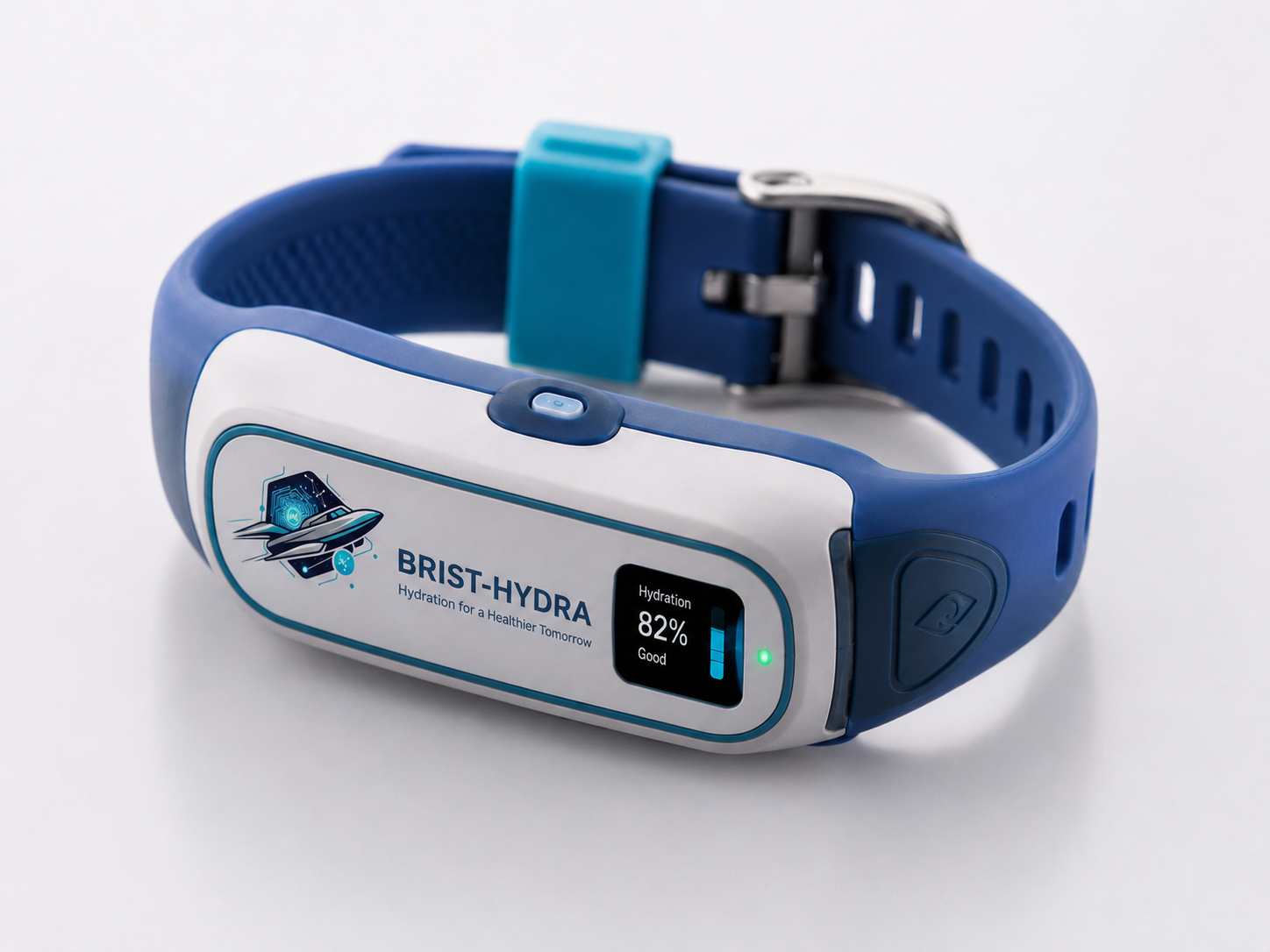
Illustrative concept of the BRIST-HYDRA child hydration-awareness wristband
Image is for illustration purposes only. The final prototype, dimensions, display, enclosure, colours and component arrangement may differ.
Proprietary Project — All Rights Reserved

BRIST-HYDRA is not an open-source project. Its concept, design, documentation, source code, circuit architecture, images and technical material may not be copied, reproduced, modified, redistributed or used commercially without prior written permission, except where permitted by applicable law.

Project Overview

Abstract

The Problem

Childhood dehydration and heat-related illness are important concerns during hot weather, sports, outdoor activity and school hours. Children may forget to drink water, while parents and teachers cannot continuously observe every child.

Early warning signs may include tiredness, headache, dizziness, weakness and reduced concentration. Severe fluid loss may contribute to heat-related illness.

The Proposed Solution

BRIST-HYDRA is a child-focused wearable concept using an Arduino UNO Mini, an experimental skin-conductance sensor, RGB indicators, an OLED display, a miniature siren and a SIM800L communication module.

When an experimental sensor value crosses a programmed warning threshold, the device produces local alerts and sends an SMS notification to the registered parent or guardian.

Keywords: Hydration awareness, children, Arduino UNO Mini, skin conductance, wearable sensors, siren and SMS alert.

Important validation notice: BRIST-HYDRA is presently an experimental awareness and reminder concept. It is not a medical device and must not be used to diagnose dehydration or replace supervision, clinical assessment or medical advice.

Current Project Stage

Development Status

Approximately 10% Completed

10%

The project is currently at the research, planning and component-identification stage. The principal sensors, compact controller, GSM module, indicators and alert devices have been identified. Procurement will begin soon.

Completed Problem identification, concept development, preliminary architecture and component selection.
Present Stage Sensor research, Arduino UNO Mini planning, SIM800L integration planning and circuit preparation.
Next Stage Procurement, breadboard development, programming, siren testing and experimental calibration.

Need for the Project

Introduction and Problem Statement

Why This Problem Matters

During hot weather, children may lose fluids through perspiration, sports and outdoor activity. They may also forget to drink water or fail to recognise early discomfort.

  • Headache and tiredness.
  • Dizziness and weakness.
  • Reduced concentration.
  • Reduced physical performance.
  • Risk of heat-related illness in severe cases.

Current Practical Challenges

  • Parents cannot continuously observe children.
  • Teachers may be responsible for many students.
  • Clinical instruments are not intended for everyday wrist-based monitoring.
  • General smartwatches may be expensive or complicated.
  • Children may ignore ordinary verbal reminders.

Proposed Operation

How BRIST-HYDRA Works

The first prototype is planned for children aged approximately 5–12 years, subject to safety, comfort and usability evaluation.

01

Skin Measurement

The skin-contact sensor records an electrical-conductance value.

02

Data Processing

The Arduino UNO Mini reads and processes the experimental sensor value.

03

Threshold Comparison

The reading is compared with calibrated green, yellow and red threshold ranges.

04

Local Warning

The LED, display and siren provide an immediate warning to the child.

05

Parent Notification

The SIM800L sends an SMS alert to the registered parent or guardian.

06

Acknowledgement

The child or supervising adult acknowledges the warning after water has been provided.

07

Automatic Recheck

The device pauses, records fresh sensor values and resumes the alert if the warning condition remains.

User Warning System

Three-Level Alert System

Green Level

Normal Programmed Range

The sensor reading is within the calibrated normal range.

Green indicator and normal status message. No siren or SMS warning.
Yellow Level

Drink Water Soon

The reading has crossed the first programmed awareness threshold.

Yellow indicator, display reminder and short periodic warning beeps.
Red Level

Immediate Hydration Reminder

The reading has crossed the higher programmed alert threshold.

Red flashing light, loud repeating siren and SMS alert to the parent or guardian.

Continuous Alert Mode

At the red alert level, BRIST-HYDRA enters a repeating siren mode. The warning continues in loud alert cycles until the child, teacher, parent or supervising adult acknowledges it. This helps prevent the warning from being ignored.

1. Red Warning The red indicator flashes and the display shows “Drink Water”.
2. Loud Siren The miniature siren produces repeated loud alert cycles.
3. SMS Alert The SIM800L sends an alert to the registered parent or guardian.
4. Acknowledge and Recheck After water is provided, the alert is acknowledged and the device performs another sensor check.

The siren is not described as automatically detecting that water has been swallowed. Instead, acknowledgement confirms that the warning has been attended to. If the programmed alert condition remains after rechecking, the warning resumes.

Wearable Concept

Product Description

Physical Design

BRIST-HYDRA is planned as a compact wrist-worn unit resembling a digital watch. Skin-contact electrodes would be positioned on the rear surface, while the front would contain a small display, visual indicators and an acknowledgement control.

  • Arduino UNO Mini-based controller.
  • Compact SIM800L communication module.
  • Lightweight enclosure.
  • Soft adjustable wrist strap.
  • Planned water-resistant design.
  • USB-rechargeable battery system.
  • Blue, pink, green or yellow colour options.

Display and Indicators

  • Smiling face for the normal programmed range.
  • Yellow reminder symbol when water should be taken soon.
  • “Drink Water” message during a red alert.
  • Green, yellow and red visual indicators.
  • Loud repeating siren at the highest level.
  • SMS notification to a parent or guardian.
  • Acknowledgement button for the child or adult.
All displayed product images are for illustration purposes only. The final prototype size, enclosure, component arrangement, display, strap, colours and appearance may differ.

Hardware Architecture

Proposed Components

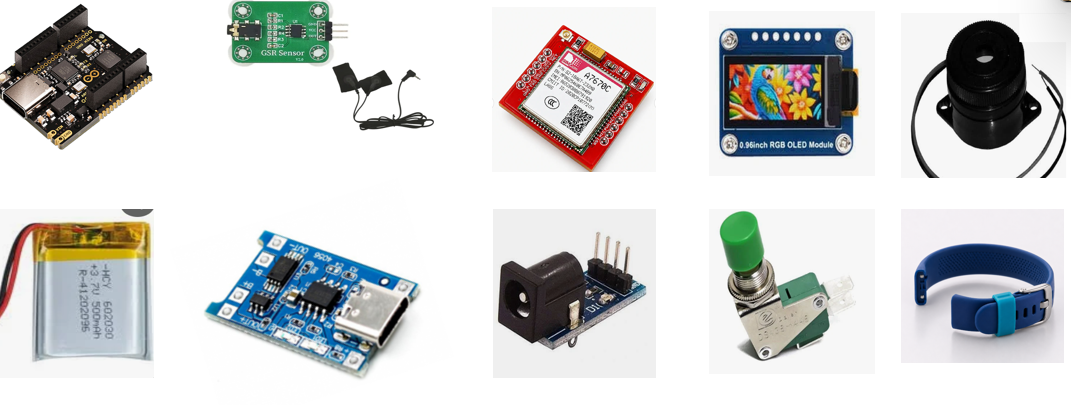
Illustrative component arrangement for BRIST-HYDRA
Components image is for illustration and planning purposes only. The final selected modules, PCB and circuit arrangement may differ.
Arduino UNO Mini Acts as the compact main controller and processes sensor readings, alert levels and communication commands.
GSR / Skin-Conductance Sensor Records changes in skin conductance for experimental hydration-awareness analysis.
SIM800L GSM/GPRS Module Provides compact GSM communication for sending SMS alerts to a registered parent or guardian.
Miniature Piezo Siren Produces a loud repeating alert when the system enters the highest warning level.
Siren Driver Circuit Uses a transistor or MOSFET driver so that the controller does not directly supply the siren current.
RGB LED Provides green, yellow and red visual indications according to the programmed alert condition.
Small OLED Display Shows status symbols, warning messages, smiley indicators and simple child-friendly instructions.
Acknowledgement Button Allows the child, teacher, parent or supervising adult to confirm that the warning has been noticed.
Rechargeable Lithium Battery Provides portable power to the wearable system through a protected power circuit.
Dedicated SIM800L Power Circuit Provides stable regulated power separately to the GSM module during network communication.
USB Charging and Protection Module Supports controlled charging and battery protection.
Skin-Contact Electrodes Maintain contact between the sensing circuit and the wearer’s skin.
Soft Adjustable Wrist Strap Supports comfortable positioning of the wearable prototype on a child’s wrist.

Preliminary Electronics Plan

Technical Description

The following connections are preliminary and may be modified during prototype development and custom-PCB design.

Component Proposed Connection Purpose
GSR Sensor Analog output to Arduino UNO Mini A0 Provides an experimental skin-conductance reading for threshold analysis.
Miniature Siren Digital control pin through transistor or MOSFET driver Produces the loud repeating red-level warning without drawing siren current directly from the controller pin.
RGB LED Three suitable digital or PWM outputs Produces green, yellow and red visual indications.
OLED Display I²C communication lines Displays status symbols and warning instructions.
SIM800L TX Arduino software-serial receive input Transfers communication data from the GSM module to the controller.
SIM800L RX Arduino software-serial transmit output through appropriate signal conditioning Receives AT commands for sending SMS alerts.
Acknowledgement Button Digital input with pull-up configuration Confirms that the warning has been noticed and temporarily pauses the siren for a recheck.
SIM800L Power Circuit Dedicated regulated battery supply Supports stable GSM operation without powering the module directly from an Arduino output pin.
Rechargeable Battery Charging, protection and voltage-regulation circuit Supplies portable power to the wearable system.

Scientific Basis

Scientific and Working Principle

Skin Conductance

A galvanic skin-response or electrodermal-activity sensor records changes in the electrical conductance of the skin. The reading may be influenced by sweat-gland activity, temperature, movement, contact pressure, electrode quality, stress and individual physiology.

In BRIST-HYDRA, this value is being investigated as one possible input for a hydration-awareness and reminder system.

Programmed Decision Logic

The Arduino UNO Mini repeatedly reads the sensor value and compares it with experimentally calibrated threshold ranges.

The selected alert level controls the display, RGB indicator, siren and SIM800L SMS communication. Red-level alerts remain active until acknowledged, followed by an automatic sensor recheck.

Skin conductance alone cannot clinically diagnose dehydration. Sensor thresholds, accuracy, safety, reliability and usefulness must be evaluated through controlled testing before any healthcare, school or public deployment.

Concept Assessment

Potential Users and Applications

Potential Users

  • Parents and guardians.
  • Schools and educational institutions.
  • Summer camps.
  • Sports clubs and training centres.
  • Child-health awareness programmes.
  • Researchers studying affordable wearables.

Proposed Advantages

  • Focused hydration reminders.
  • Simple child-friendly indicators.
  • Loud warning that is difficult to ignore.
  • SMS communication with a guardian.
  • Compact controller and GSM module.
  • Intended use of affordable components.

These benefits remain design objectives and must be confirmed through prototyping, costing, safety testing and user evaluation.

Planned Development

Future Scope

Integration of a heart-rate sensor.
Integration of a body or skin-temperature sensor.
Development of a compact custom PCB.
Replacement of development modules with smaller production components.
Further reduction of enclosure size and weight.
Sleep and daily-activity tracking.
A separate version for elderly users.
A school dashboard for participating students.
Improved calibration using controlled experimental data.
Mobile-application and guardian-dashboard connectivity.
A lower-cost version for villages and resource-limited regions.
Evaluation for schools, sports clubs and summer camps.

Project Funding Support

BRIST-HYDRA received funding support from MAASTEK Technologies for research, component procurement, PCB development, prototyping and future technical advancement.

₹80,000
View Funding Certificate